Packaging your product sustainably is becoming increasingly important. As of 2030, new European PPWR legislation requires packaging to be at least 70% recyclable. This requires materials that are easy to process. Mono-material is a common solution for this: this packaging consists entirely of one type of plastic. Often this is PE or PP. But what exactly is the difference between the two? Rob Engelman explains.
Your pouch is ready for the 2030 PPWR guidelines.
PE and PP are fully recyclable within existing recycling streams.
Both plastics can be processed into various pouches, such as stand-up pouches or flat bags.
Both PE and PP help lower transportation costs and reduce CO₂ emissions in the chain.
Mono-PE is packaging made entirely of one type of plastic: polyethylene (PE). PE is one of the most widely used plastics worldwide. That brings an important advantage, Rob Engelman explains: it can be easily recycled through the regular plastic stream. PE consists of carbon and hydrogen atoms. That has a practical advantage. Rob: “No toxic substances are released during recycling. That pure composition as well as its versatility make PE suitable for all kinds of applications.” A major advantage of PE is its light weight – pleasant to use and efficient in transport. In addition, the material is wear-resistant, resistant to acids, bases and chemicals and has a long life. There are several varieties of PE: LDPE (Low-Density PE), LLDPE (Linear Low-Density Polyethylene) and HDPE (High-Density PE). The difference? “LDPE is flexible and pliable and is widely used in films and stand-up pouches,” Rob explains. Want to know which combination is right for your product? Then get in touch with us!
Another common option is mono-PP packaging: packaging made entirely of the plastic polypropylene (PP). “This plastic is known for its high impact resistance, chemical resistance and good temperature resistance. This makes PP useful for animal feed and supplements, for example,” Rob says. ” PP offers a strong combination of rigidity and flexibility, and – like PE – is easily recyclable, making it a future-proof choice. A unique property of PP is that it can be bent back and forth almost endlessly without tearing. In addition, it is lightweight, wear-resistant, acid-resistant and water-repellent.” PP can be used in pouches as a complete mono-material, but also as a specific seal or barrier layer within a multi-layer construction. It seals well thermally, is heat resistant and forms a strong barrier against external influences. “Ideal for products that must remain well protected,” concludes Rob.
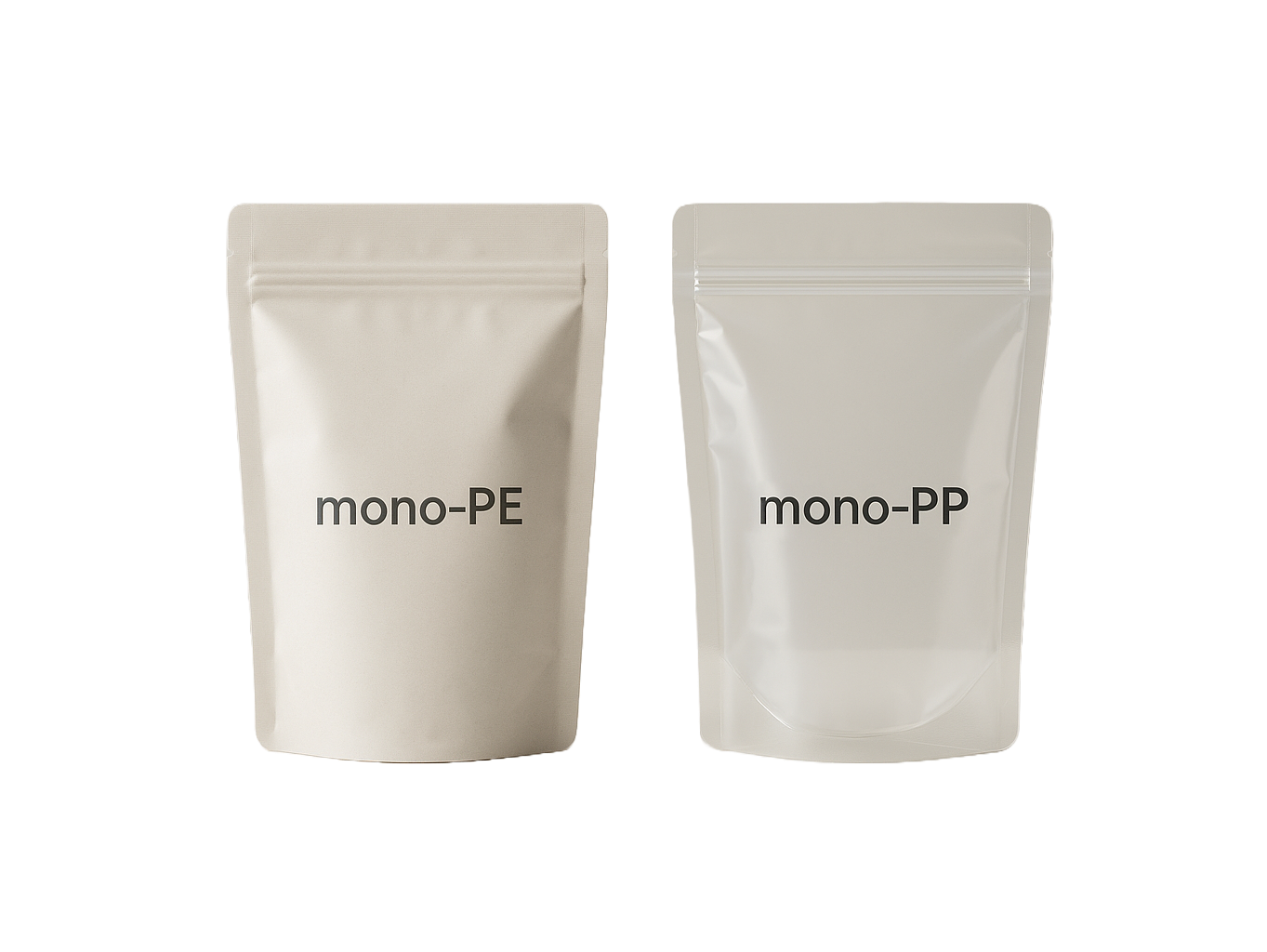
Polypropylene (PP) and polyethylene (PE) are both common plastics used for pouches, but each has its own unique properties. “PP is stiffer and stronger, more resistant to heat (up to ±100°C) and ideal for packaging that needs to keep its shape,” Rob says. “Think tight stand-up pouches for supplements or pouches with a clear window for coffee or nuts. PE, on the other hand, is more flexible and shock-resistant, and performs better at low temperatures. This makes it perfect for large bags of pet food, flexible bulk packaging or applications where the packaging needs to withstand a bump. In terms of appearance, PP tends to be more transparent, which is useful if the contents need to be visible. PE has a more milky appearance, but generally offers better protection against aggressive substances – for example, with supplements containing active ingredients.” Both materials are easily recyclable, Rob says, although PP tends to last longer, while PE is pricier. “Choose PP in the case of form-fitting, luxury or heat-resistant pouches. Choose PE for flexible, shock-resistant packaging.”
Choose mono-PE or mono-PP and reduce environmental impact.
Both plastics are safe and widely applicable – from animal feed to supplements and coffee.
Whether you need a flexible or rigid pouch, PE and PP offer a suitable solution.
With mono-materials, you are prepared for PPWR legislation.
Our team of experts is ready to work with you to find the perfect packaging solution.
Request advice